Rubidium Dispensing for Quantum Technologies
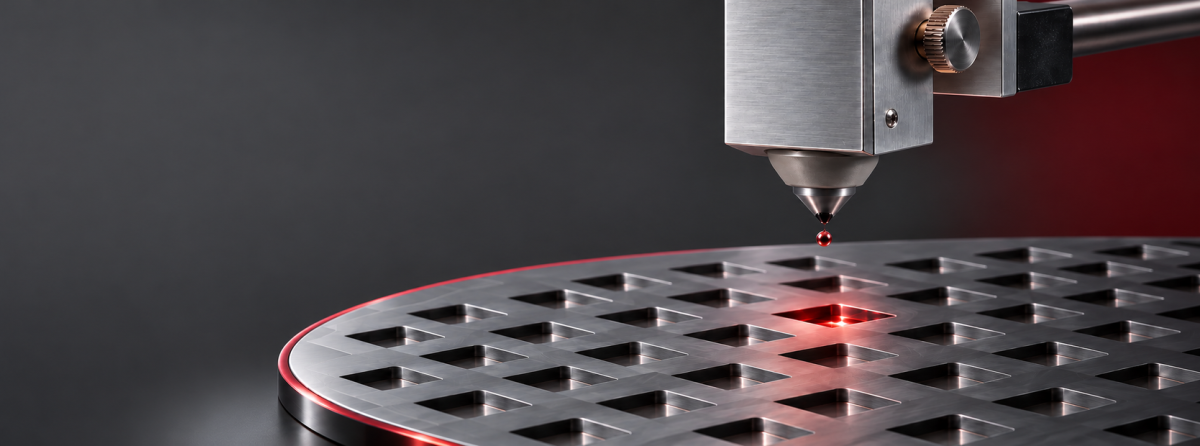
Contactless Rubidium Dispensing for Quantum Technologies
Picoliter-scale deposition of molten rubidium for microfabricated vapor cells and quantum sensing applications.
Quantum technologies are driving the development of increasingly compact atomic clocks, magnetometers and advanced sensing devices. Manufacturing these devices requires the precise introduction of extremely small quantities of alkali metals into microfabricated vapor cells.
At microdrop Technologies, we have gained practical experience in the contactless dispensing of molten metallic rubidium (Rb) using our piezoelectric drop-on-demand technology.
Combined with precise positioning, controlled heating and an inert process environment, our technology offers promising possibilities for developing automated vapor cell filling processes.
Key Benefits of Direct Rubidium Dispensing
Pure rubidium. No solvents. No precursors.
Direct deposition of elemental rubidium without chemical conversion.
Program material quantities, drop by drop.
Adjust deposited quantities through programmable droplet sequences.
Automated positioning with Autodrop Gantry II.
Target selected cavities with programmable positioning.
Flexible, contactless deposition.
Adapt deposition positions and patterns to different device layouts.
Observe drop formation with Image Control.
Support process setup and droplet inspection through optical monitoring.
The Challenge: Precision at the Picoliter Scale
Microfabricated alkali vapor cells require the precise introduction of extremely small quantities of reactive materials into microscopic cavities. As device dimensions decrease, material handling, positioning and process control become increasingly demanding.
Precise Material Quantities
Controlled deposition of extremely small volumes.
Accurate Positioning
Targeted dispensing into individual microcavities.
Controlled Environment
Handling reactive materials under suitable atmospheric conditions.
Reproducibility
Consistent droplet generation and programmable sequences.
Automation Potential
Integration into scalable microfabrication processes.
Digital Rubidium Dispensing – Our Technical Approach
At microdrop Technologies, we have investigated the contactless dispensing of molten elemental rubidium using our piezoelectric MD-K-240 dispensing head.
Rubidium has a relatively low melting point of approximately 39.3 °C, making liquid-phase dispensing possible with a suitably heated system. Our trials use controlled heating and an inert atmosphere to handle this highly reactive material.
By combining piezoelectric drop-on-demand technology with programmable positioning, individual rubidium droplets can be deposited into selected microcavities without direct contact between the dispensing head and the substrate.
This approach offers a flexible basis for developing precise, automated filling processes for microfabricated vapor cells.
MD-K-240
Piezoelectric dispensing head with glass capillary.
Autodrop Gantry II
Programmable three-axis positioning.
Controlled Heating
Heated enclosure around reservoir and dispenser.
Inert Atmosphere
Glovebox integration for reactive material handling.
From Droplet to Wafer
A controlled process for digital rubidium deposition.
Our dispensing concept combines controlled heating, optical droplet inspection and programmable positioning to deposit molten rubidium into selected microcavities.
The individual process steps can be adapted to specific device geometries and application requirements.
HEAT
Melt elemental rubidium at approximately 60 °C under an inert atmosphere.
FILL
Transfer molten rubidium into the heated dispenser reservoir.
CHECK
Inspect droplet formation using integrated optical monitoring.
DISPENSE
Position the dispensing head above selected microcavities and deposit programmed droplet sequences.
Dispensing of Rubidium Azide and Alkali-Metal Precursors
In addition to the direct dispensing of molten metallic rubidium, microdrop Technologies has practical experience in the contactless dispensing of rubidium azide (RbN₃) solutions using piezoelectric drop-on-demand technology.
This approach enables the precise deposition of small quantities of alkali-metal precursor solutions into selected microstructures, providing another option for vapor cell manufacturing.
While direct rubidium dispensing introduces elemental metal without requiring chemical conversion, precursor-based dispensing allows rubidium-containing solutions to be deposited and subsequently processed to obtain the desired alkali-metal species.
Both approaches offer distinct advantages depending on the application, device design and manufacturing requirements.
Developing a
Quantum Technology Application?
Whether you are developing microfabricated vapor cells, exploring rubidium deposition or optimizing a quantum device manufacturing process, our team is ready to discuss your application requirements.
Talk to our application specialists →Technical Information
Digital Rubidium Dispensing
Picoliter drop-on-demand deposition for microfabricated atomic vapor cells. Technical overview, indicative trial parameters and system configuration.
View PDF →